 TM
TMOntario bistro builds its menu from its farm's 150 crops
Chefs Ben Denham and Ashley Lloyd start every menu at White Lily Farms, the 10-acre farm that supplies their restaurant, Sundays.
- Who Sundays
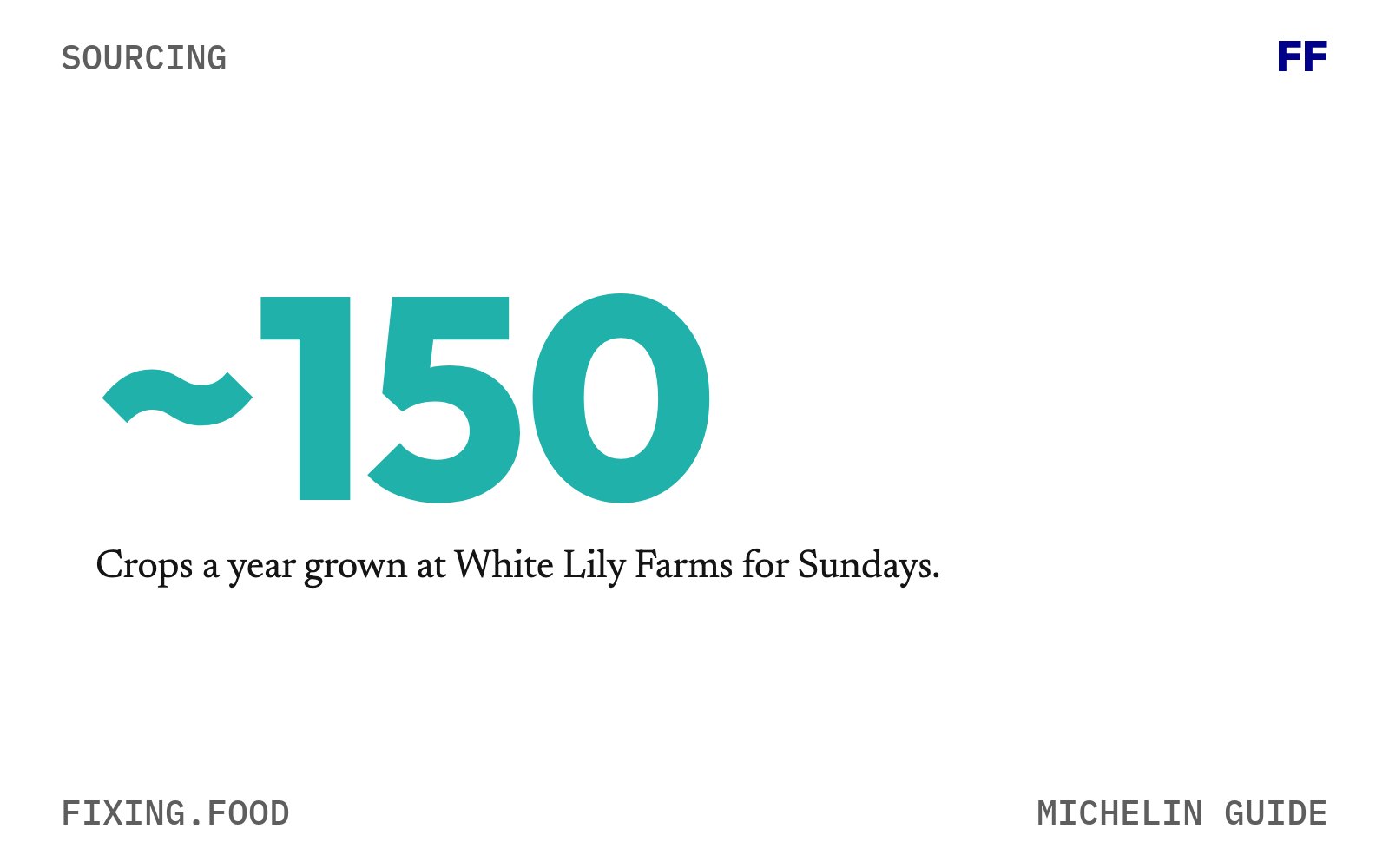
- What ~150 crops a year grown at White Lily Farms for Sundays
- When Sept. 28, 2026
- Source MICHELIN Guide ↗
Every morning, before service, chef Ben Denham walks the fields and greenhouses at White Lily Farms, a 10-acre farm near Uxbridge, Ontario, about an hour north of Toronto. What he finds there becomes the menu at Sundays, the small bistro he runs in town with his wife and fellow chef, Ashley Lloyd. "I often joke that our menu writes itself," Denham told the MICHELIN Guide in a profile published Sept. 28, 2026.
Many kitchens write the menu first and then order the food to cook it. Sundays works the other way around. The farm grows roughly 150 distinct crops a year, and the kitchen cooks from whatever is ready, with neighboring farms supplying the rest. In the busiest growing months the restaurant can run on produce from its own farm alone, though Denham says they are not strict about it.
That matters for any kitchen that wants to buy closer to home, because it moves the biggest menu decision from the order sheet to the planting plan. Chef Dominique Crenn runs her Bay Area menus the same way from her farm in Sonoma Valley, and the idea works at a ballpark too: the rooftop farm at Fenway Park in Boston has grown more than 55,000 pounds of produce in ten years.
How the farm sets the menu
The menu starts with what is growing and changes through the year with what the team is excited about. Right now that means dishes like a scallop crudo with a habanada pepper vinaigrette, shaved fennel and green Lobo radish, and a bison tartare with quick-pickled zucchini and baby gem lettuce. The bison comes from a herd that grazes a few minutes from the restaurant.
The farm grows variety on purpose. Instead of planting big fields of a few crops, the team trials small plots of unusual ones, and it can grow more than 30 kinds of heirloom tomato and more than 10 kinds of pepper. The farm also sells wholesale to 15 to 20 other restaurants from mid-May until November, and those chefs help shape what gets planted. Each week it sends out a fresh list of 40 to 50 products, from herbs and flowers to greens, fruit and vegetables. What the farm doesn't grow, like sweet corn, the kitchen buys in when it is in season.
What happens to the surplus
A farm-led menu still has to get through an Ontario winter. When the harvest runs ahead of the kitchen, the team puts away as much as it can: it cures onions, shallots and garlic, and stores carrots, cabbages and beets. In early fall it plants cold-hardy crops in the greenhouses, which keeps fresh greens and herbs coming well into the winter. The winter menu carries fewer vegetables.
How they got here
Denham started as a dishwasher in a bistro in his hometown while he was in high school, went to hospitality school in Toronto and spent about 15 years in Toronto kitchens, where he met Lloyd. The two opened their first restaurant together in 2016. When restaurants closed in 2020 they turned to organic farming, and they had bought a farm by that fall. They later took over a small licensed cafe in Uxbridge, where commercial space is hard to find, and made it Sundays, so the restaurant and the farm could sit close together.
A chef who wants to try this without buying land can start the way Sundays works with its neighbors: ask a nearby grower what will be ready in the next few weeks, and write one dish around it.
I often joke that our menu writes itself.Ben Denham, chef, Sundays
